


According to the latest science, the world is heading towards an inevitable overshoot of the 1.5°C global average temperature rise limit set by the Paris Agreement. This breach will lead to intensifying climate impacts which, coupled with recent conflict-driven energy shocks, underscore the urgent need for phasing out fossil fuels, transitioning to sustainable energy and strengthening climate resilience.
In this context, climate action presents one of the greatest opportunities to transform economies and societies for more sustainable, resilient and inclusive growth. With the majority of countries having put forward their new enhanced national climate plans (NDCs) as well as National Adaptation Plans (NAPs), the world has set solid foundations for the future of climate action.
The UN System played a critical role in supporting over 100 countries to deliver more ambitious and higher quality third-generation NDCs, under the Climate Promise 2025 initiative. Now, as countries accelerate implementation, it is well positioned to play a key role in advancing climate action globally.
During the opening of the Leaders' Summit at COP30 in Belem, Brazil, the UN Secretary-General reiterated the steadfast support of the UN System and directed UNDP to build on the infrastructure of the Climate Promise and work with all other UN agencies to support developing countries to accelerate NDC implementation.
Climate Promise: Forward was created in response to the UN Secretary-General's commitment, providing a common framework for the UN System to support NDC and NAP implementation. This framework builds on Climate Promise 2025, drawing on insights and lessons learned from UNDP, the broader UN System and the NDC Partnership and its members, all of which have been supporting NDC and NAP implementation over the past decade. It embeds NDC and NAP implementation in the existing UN system architecture and processes of UN Sustainable Development Cooperation Frameworks and UN country programmes, rather than creating a parallel process.
Areas of Support
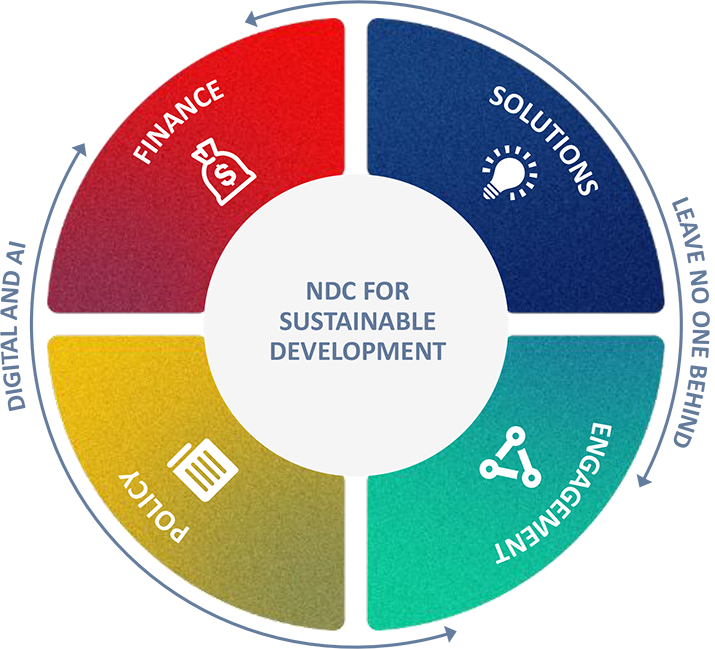
Climate Promise: Forward operates under four evidence-based levers.
These levers are:
- Policy: Strengthening coherence and institutional and regulatory frameworks across climate, environment and sustainable development agendas
- Finance: Mobilizing and attracting investment from public, private and innovative source
- Solutions: Accelerating delivery and scaling up integrated solutions on mitigation, adaptation and loss and damage
- Engagement: Strengthening whole-of-society engagement, participation and country ownership.
These four levers are complemented by two key cross-cutting accelerators proven to help deliver impact: the principle of leaving no-one behind and new digital and artificial intelligence (AI) technologies.
UN Partners
- Council of Engineers for the Energy Transition (CEET)
- Climate Security Mechanism (CSM)
- United Nations Development Coordination Office (DCO)
- United Nations Department of Political and Peacebuilding Affairs (DPPA)
- Food and Agriculture Organization of the United Nations (FAO)
- International Labour Organization (ILO)
- International Organization for Migration (IOM)
- International Renewable Energy Agency (IRENA)
- International Trade Centre (ITC)
- International Telecommunication Union (ITU)
- Joint Sustainable Development Goals Fund (Joint SDG Fund)
- Office of the United Nations High Commissioner for Human Rights (OHCHR)
- United Nations Office for Disaster Risk Reduction (UNDRR)
- United Nations Tourism (UN Tourism)
- United Nations Entity for Gender Equality and the Empowerment of Women (UN Women)
- United Nations Conference on Trade and Development (UNCTAD)
- United Nations Development Programme (UNDP)
- United Nations Environment Programme (UNEP)
- United Nations Framework Convention on Climate Change (UNFCCC)
- United Nations Population Fund (UNFPA)
- United Nations Children's Fund (UNICEF)
- United Nations Industrial Development Organization (UNIDO)
- United Nations Office for Project Services (UNOPS)
- United Nations Water (UN-Water)
- World Intellectual Property Organization (WIPO)
- World Meteorological Organization (WMO)
Latest Updates
See all
