
Module 2 - Consultation and Consent
What this module covers
Many carbon market activities, particularly nature-based ones, take place on lands and territories that Indigenous Peoples and local communities own, use or occupy. Whether those communities take part in decisions about an activity, and whether Indigenous Peoples are able to give or withhold their consent, is central to whether their rights are respected. Activities that proceed without their participation, or without the consent of Indigenous Peoples where it is required, can restrict their access to lands and resources, lead to physical or economic displacement, or deny them a fair share of benefits. For many Indigenous Peoples, this compounds a history of dispossession and exclusion from decisions that affect them. Their participation also affects the permanence of emission reductions and removals and whether credits can be issued for them. Opposition from affected communities and unresolved disputes over land and resources can disrupt implementation and lead to reversals, and unresolved claims to the rights to emission reductions and removals can prevent issuance.
Carbon crediting mechanisms, from the Paris Agreement Crediting Mechanism (PACM) to independent crediting standards, set requirements on stakeholder engagement and, in different ways, on free, prior and informed consent (FPIC). The Integrity Council for the Voluntary Carbon Market (ICVCM) includes criteria on both. Their terminology differs, but the core elements are shared: identifying who may be affected, sharing information before consultation, consulting before design is finalized, obtaining consent where FPIC applies, resolving grievances and continuing engagement through the crediting period.
This module builds on these shared elements. It is grounded in UNDP’s Social and Environmental Standards, which were designed in alignment with international human rights instruments, including the United Nations Declaration on the Rights of Indigenous Peoples, ILO Convention 169 and the core UN human rights treaties, as well as multilateral environmental agreements.
How the module is organized
Module 2 has three parts. Each addresses the same process from a different position: what stakeholder engagement involves and what is expected of those who design and carry out activities (Part 1); how Indigenous Peoples’ right to free, prior and informed consent applies to carbon market activities (Part 2); and how communities can prepare for, negotiate and implement an agreement when a carbon project is proposed on their land (Part 3).
The three parts are accompanied by UNDP’s case study series, Advancing Social Integrity in Forest Carbon Initiatives: Insights from Brazil, Costa Rica and Ecuador, which examines REDD+ processes supported by results-based payments and draws out lessons for carbon markets. A photo story, Living Forests, Living Rights, presents the same three countries through the perspectives of Indigenous Peoples, women and traditional communities. Technical Insights blogs by UNDP and partner organizations draw on national REDD+ processes, project assessments and grant-making.
Part 1 - Stakeholder engagement
Stakeholder engagement in carbon markets sets out practical considerations for engaging stakeholders in carbon market activities. It covers stakeholder analysis and engagement plans, how engagement scales with the significance of an activity’s risks, and where engagement fits at each stage of the project cycle. It also addresses disclosure, grievance and protection against reprisals. The target audience is project developers, host country governments, validation and verification bodies and others who design or review engagement processes.
Part 2 - Free, prior and informed consent
Free, prior and informed consent (FPIC) in carbon markets explains what FPIC is, how it differs from consultation, and what carbon market frameworks require. FPIC derives from the collective rights of Indigenous Peoples recognized in international human rights instruments, and is also required of developers through national law, the conditions of host country approval and the frameworks under which activities are registered. The guidance addresses when and to whom FPIC applies, how Indigenous Peoples are identified, and how FPIC is applied in practice, together with common challenges. The target audience is project developers, host country governments, validation and verification bodies and others who design, carry out or review consent processes.
Part 3 - Negotiating carbon project agreements
Negotiating carbon project agreements sets out practical considerations for Indigenous Peoples and local communities when a carbon project is proposed on their lands, territories or resources. It addresses projects that directly affect community land, such as forest, farming, wetland and renewable energy projects. Adapted from How to Negotiate with Carbon Project Developers: A Practical Toolkit for Grassroots Advocates, developed by Namati and the Grassroots Justice Network from experience with carbon projects in 21 countries, it follows four steps: preparing to engage, proposing terms, negotiating, and implementing a project agreement through governance, management of funds, monitoring, redress and review. The target audience is community representatives and the organizations that support them.
Living Forests, Living Rights: Advancing Social Integrity in Climate Action
Experiences from Brazil, Costa Rica and Ecuador show how Indigenous Peoples, women and traditional communities are leading forest climate action as rights-holders, decision-makers and stewards of their ecosystems.

UNDP resources
UNDP's case study series, Advancing Social Integrity in Forest Carbon Initiatives: Insights from Brazil, Costa Rica and Ecuador, examines REDD+ processes supported by results-based payments in three countries and draws out lessons for carbon markets.
Advancing Social Integrity in Forest Carbon Initiatives
Introduces the three case studies, which draw on UNDP's experience applying its Social and Environmental Standards in jurisdictional REDD+ programs supported by Green Climate Fund results-based payments. It sets out what social integrity means in forest carbon initiatives and draws out cross-cutting lessons.
Insights from Brazil
Examines how social integrity was put into practice within Brazil's jurisdictional REDD+ framework through the Floresta+ Amazônia Project, with a focus on its support for small projects developed by organizations representing Indigenous Peoples and traditional peoples and communities.
Insights from Costa Rica
Examines how Costa Rica linked results-based payments to Forest and Territorial Environmental Plans developed by each Indigenous Territory through its own decision-making processes, and the role of the 2018 Consultation Mechanism and cultural mediators in that process.
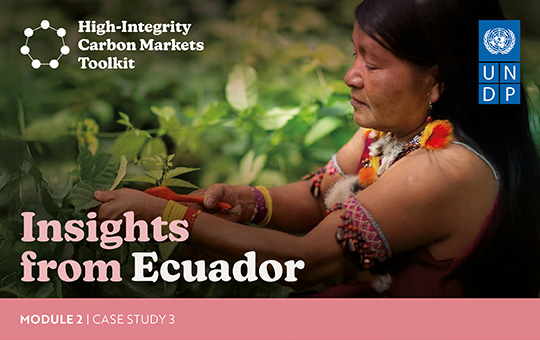
Insights from Ecuador
Examines how Ecuador developed a participatory framework for free, prior and informed consent in Indigenous Peoples' territories, and how engagement with Indigenous representative organizations at multiple levels shaped REDD+ design and implementation.
Technical insights
Short pieces by UNDP and partner organizations on stakeholder engagement and consent in carbon markets, drawing on national REDD+ processes, project assessments and grant-making.

What Costa Rica’s REDD+ experience can teach us about social integrity
Yanory Rojas, a Boruca Indigenous woman, and UNDP examine how UNDP’s REDD+ Results-Based Payments project built on Costa Rica’s national consultation process with Indigenous Peoples, and how territorial plans developed by each Indigenous Territory became a condition for receiving payments.

Beyond consultation: how communities can shape jurisdictional REDD+
Drawing on the Kawari Fund’s grant-making in 12 countries and 25 jurisdictions, Kawari Fund and UNDP set out four lessons on what it takes for Indigenous Peoples and local communities to move from attending consultations to shaping decisions in jurisdictional REDD+.

What project assessments reveal about stakeholder engagement
Drawing on its assessments of more than 100 carbon projects, Calyx Global finds that evidence of stakeholder engagement is often the weakest part of a project’s safeguards record and is thinnest for industrial and technology-based projects. Weak engagement also often goes hand in hand with gaps in other safeguard areas.